
WhatsApp Banned: The Risk of Selling Through an Unofficial Number
Sending bulk messages from an unofficial number can get your WhatsApp banned—and take your customer history with it. See why the official API protects your sales.
By Gabriel Borges Aguiar · November 19, 2026 · 7 min read
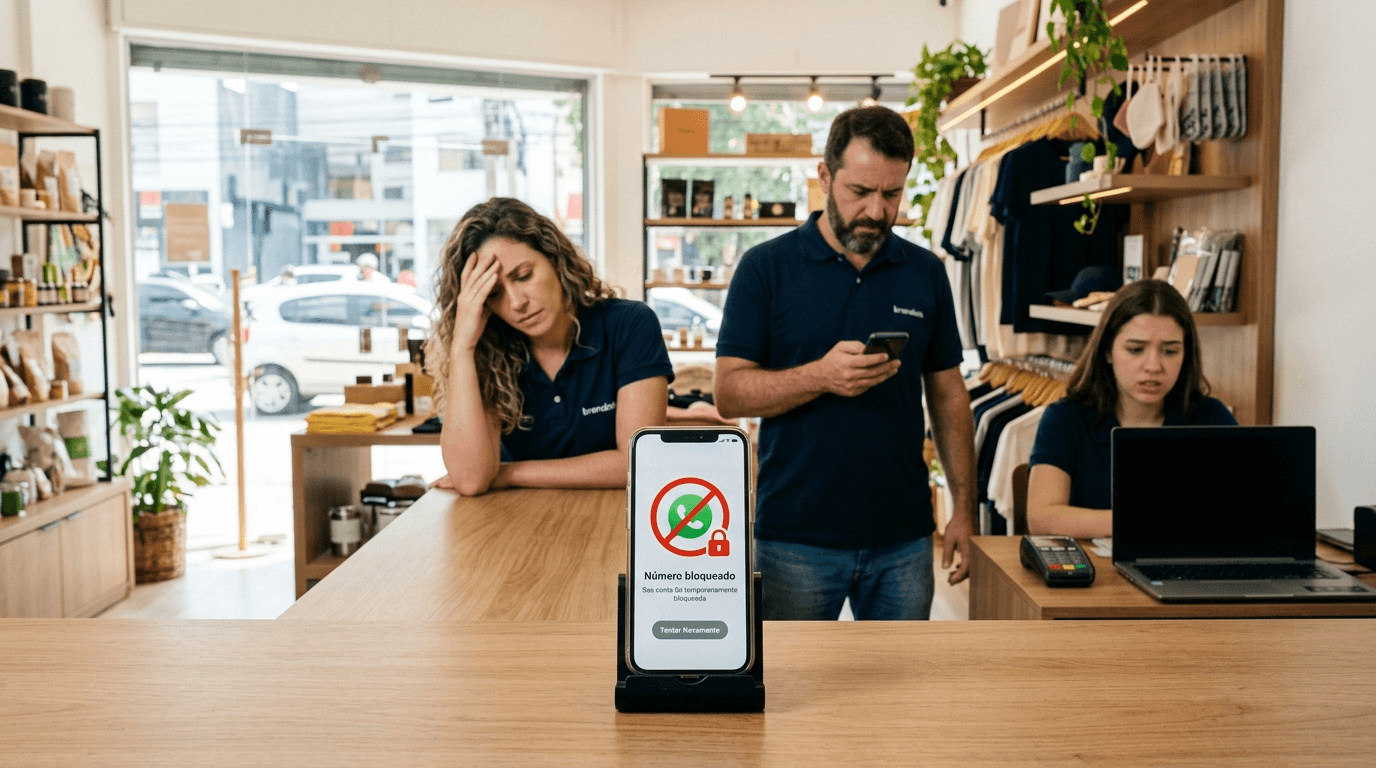
WhatsApp Blocked: The Risk of Selling Through an Unofficial Number
On a Monday morning, the sales team opens its phone and sees the message no one wants to read: this number can no longer use WhatsApp. Along with the number go years of conversations, saved contacts, deals in progress, and customers who will now send a message to a channel that doesn’t respond.
For many businesses, that day comes as a surprise. But it’s almost never bad luck. In most cases, the block is a direct consequence of how the business had been using WhatsApp: modified apps, “off-the-books” bulk messaging tools, automations that imitate a human clicking, and contact lists whose members never agreed to receive messages.
For businesses that depend on WhatsApp to sell, the question is no longer whether it’s worth using the official channel. The question is how much it costs to keep operating a revenue channel that could disappear at any moment.
Why the Shortcut Seems to Work—Until It Doesn’t
Unofficial solutions are often appealing at first. They’re cheap, don’t require message template approval, and promise to send thousands of messages in minutes. Many work by connecting a regular cell phone to a computer and simulating a person’s actions, with no affiliation with Meta.
The problem is that this model violates the platform’s rules. In 2026, number bans surged in Brazil as enforcement against unauthorized tools and bulk messages sent without recipients’ consent intensified. When volume is low, a business might go unnoticed. As operations grow, so does the risk.
There’s also a knock-on effect that few people consider. If a device has already had numbers banned, new numbers activated on it may be automatically blocked by association. Swapping the SIM card and starting over, as many teams do, doesn’t always solve the problem. emdigisac
What Your Business Loses When Its Number Is Shut Down
The most obvious loss is a stalled customer service operation. But that’s just the beginning.
The first cost is the conversation history. Customer chats, quotes, receipts, and agreements are stuck on a number that no longer exists. If this information wasn’t recorded in a CRM, the business loses its relationship history.
The second is lost sales momentum. Leads in the middle of a deal send a message, get no reply, and move on to a competitor. Repeat customers have that number saved in their contacts and don’t know the new one. Ad spend that was driving people to WhatsApp now goes nowhere.
The third is reputational damage. A number that sends messages without consent is seen as spam by the very customers the business wants to reach. Even before a ban, reports erode trust in the brand and lower response rates.
Finally, there’s the issue of data. Tools with no official affiliation with the platform access customer conversations and contact information without the contractual safeguards required by Brazil’s LGPD for those processing personal data on behalf of a business.
Official API or “Pirate API”: What’s the Difference in Practice?
The WhatsApp Business Platform, commonly known as the official API, is the channel Meta provides for businesses to communicate with customers at scale. It’s accessed through authorized providers, which undergo verification and operate within the platform’s policies.
In practice, the difference comes down to four things. The number is linked to a verified business, not a standalone phone left in a drawer. Outbound messages—those initiated by the business—use templates approved by Meta. Sending limits increase based on conversation quality, protecting the number from spikes that could lead to a ban. And multiple people and AI agents can handle customer service at the same time on the same number, with conversation history integrated into the company’s systems.
This doesn’t mean anything goes with the official API. The platform still evaluates quality: if many customers block or report the business, restrictions may apply. The difference is that the rules are clear and the operation is built to follow them, rather than trying to get around them.
What About Artificial Intelligence in This Scenario?
A common question since late 2025 is whether AI can still provide customer service through WhatsApp. The answer is yes, as long as it serves the business. The January 15, 2026 update prohibits providers from offering general-purpose AI assistants—where the AI itself is the product. In other words, the rule targets generic chatbots distributed through WhatsApp, not businesses that use AI to serve customers, qualify leads, and sell their own products to their own customers.
That’s another reason to work with an official provider: those operating within the platform keep up with policy changes and adapt their operations before they become a problem for the customer. whapi
Signs Your Operation Is at Risk
Some practices indicate that your sales channel may be more vulnerable than it seems:
1. Your company’s WhatsApp runs on a physical phone that someone has to keep powered on, charged, and connected.
2. Your team uses modified versions of the app or extensions that promise bulk messaging, automatic replies, or support for multiple agents.
3. Your campaigns go to purchased lists or to contacts who never asked to receive messages.
4. You’ve already had a temporary ban and the fix was to switch SIM cards.
5. Customer history exists only on the phone, with no CRM records.
If two or more of these apply to your business, the risk isn’t theoretical. It’s only a matter of time.
How to Migrate to the Official Channel Without Stopping Sales
The migration doesn’t have to be traumatic. The most important thing is to plan so customers don’t feel the change.
1. Verify your business in Meta Business Manager. Confirmed business documentation and domain verification are the foundation for operating the official API with credibility.
2. Choose an official provider. Confirm that the provider has a direct relationship with Meta and that the number is registered in your company’s name, not the provider’s.
3. Organize your contacts and confirm consent. Separate people who already communicate with your business from those who have authorized you to contact them. Sending bulk messages to a cold list doesn’t become acceptable just because you’ve switched channels.
4. Integrate customer service with your systems. Connect your CRM, ERP, and payment methods so every conversation is recorded and the history belongs to the business, regardless of the device or agent.
5. Notify active customers about the change. If the number changes, notify them through existing channels before the switch and keep a forwarding message in place for as long as needed.
What to Measure After the Migration
The first metric is stability: the channel stops experiencing interruptions. Next, monitor the number’s quality rating on the platform, the rate of blocks and reports per campaign, the response rate to outbound messages, and the percentage of conversations recorded in the CRM.
It’s also worth comparing conversion rates before and after. Businesses that replace bulk messaging with consent-based conversations tend to send fewer messages and make more sales per message sent, because they’re talking to people who actually want to hear from them.
Security Is Also a Sales Strategy
WhatsApp has become the main sales counter for many Brazilian businesses. Treating this channel like an improvised cell phone means putting revenue on a foundation the business doesn’t own and that can be switched off without warning.
Vendedor IA runs on the official WhatsApp Business API, with an integration certified by TECTO, an official Meta provider. The number is verified, conversation history is integrated with the CRM and the company’s systems, and AI agents serve customers, qualify leads, and make sales within the platform’s policies, with human staff stepping in when the conversation calls for it. The result is a channel that can grow in volume without increasing risk.
Selling through WhatsApp remains one of the most effective ways to convert customers in Brazil. The difference lies in building that operation on a channel that will still be up and running tomorrow.